
On a sunny Saturday in May 2026, hundreds of people gathered in Turners Falls, Massachusetts, to honor and remember the 300 elders, women and children slain on May 19, 1676, at a site less than a mile away. In one of the worst atrocities of King Philip’s War, Captain William Turner’s colonial forces attacked and killed hundreds of non-combatants in the predawn darkness. The Day of Remembrance, organized by the Nolumbeka Project on the 350th anniversary of the massacre, was an act of mourning. Yet it also celebrated a moment when the telling of history changed.
In place of the traditional story of a colonial heroic victory - ending the “thraldom of barbarism” of Indigenous people in the Pocumtuck valley - there were new signs telling the true story of May 19, 1676. A land deed changed hands, from a colonial-legacy institution to a Native organization and tribes. Music spilled across the lawn, with drumming and song by musicians including the Eastern Medicine Singers and Strong Eagle Many Feathers Daly. Vibrant, powerful art covered the walls of the nearby hall, works by Deborah Spears Moorehead, Seaconke Pokanoket Wampanoag, and Robert Peters, Mashpee Wampanoag. Speakers included Pat Allen, chair of the selectboard on May 19, 2004, when the reconciliation agreement between the town of Montague and the Narragansett was signed; Nulhegan Abenaki author and anthropologist Dr. Marge Bruchac; award-winning poet Martin Espada; Liz Coldwind Santana-Kiser, elder and council member of the Chaubunagungamaug Band of Nipmuck Indians; and Roger Longtoe Sheehan, Elnu Abenaki chief and musician. The emcee was David Brule, chair of the Nolumbeka Project and coordinator of the Battlefield Study Grant Advisory Board.
Here we reproduce the speech by Liz Coldwind Santana-Kiser, elder and council member of the Chaubunagungamaug Band of Nipmuck Indians, and a shortened version of an article by Nolumbeka Project president David Brule, originally published in the Montague Reporter. Photos by Carol Fournier.
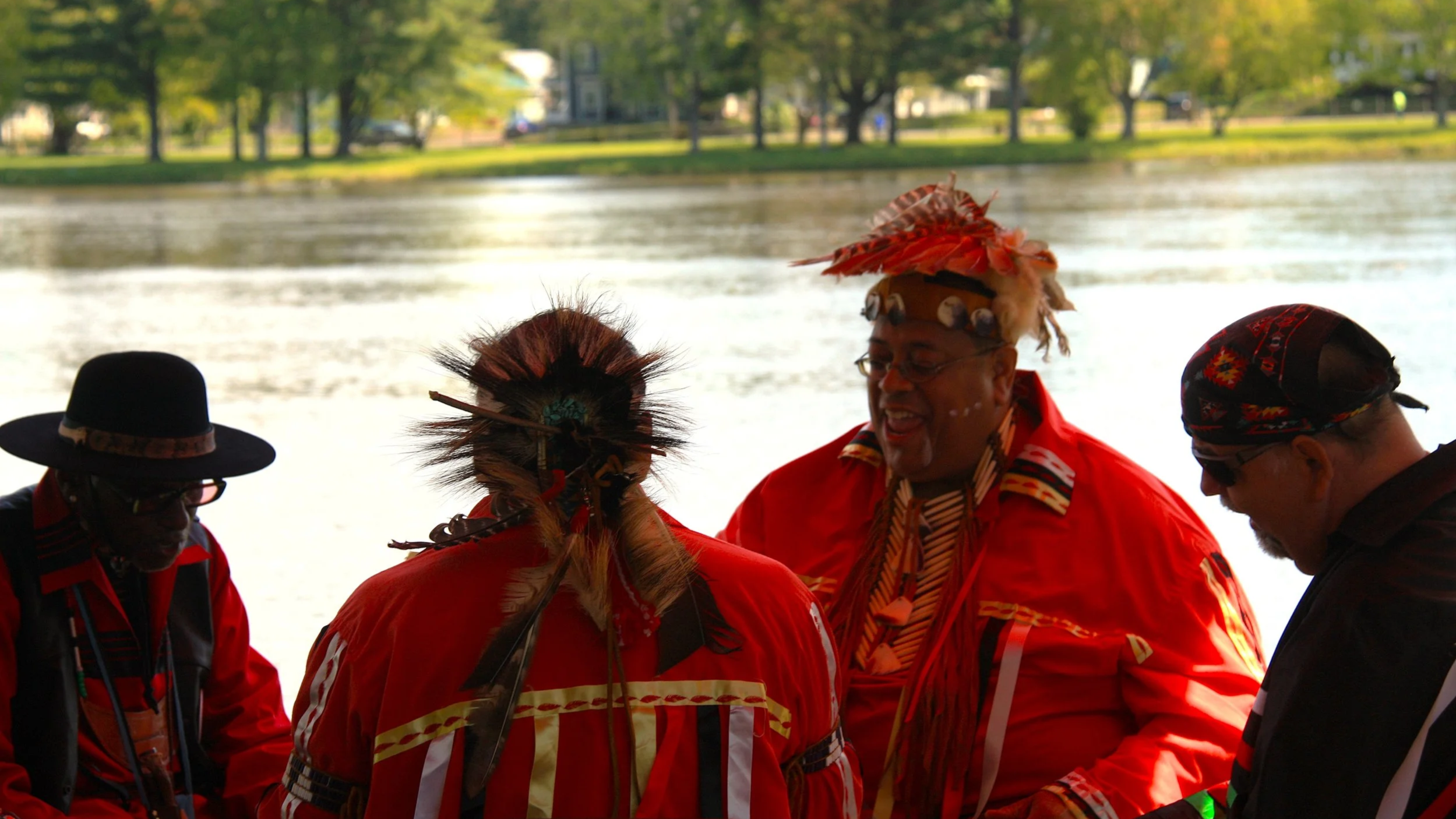
The Eastern Medicine Singers - Rob Two Running Elks Cox, David Grey Owl Jennings, Dean Running Deer Robinson, and Daryl Black Eagle Jamieson - offer a healing song with the Kwinitekw, the Connecticut River, at Unity Park, Turners Falls, Mass., to begin the 350-year commemoration of the massacre at Peskeompskut Falls, May 16, 2026. Photo courtesy of Carol Fournier
“to all of you here with us and my ancestors who are not. Today I speak the truth not found in our history books.”
- Liz Cold Wind Santana-Kiser
“To all of you here with us and my ancestors who are not. Today I speak on the truth not found in our history books. The year 1676 is a date in our memory that should never be forgotten. It was a year when the rivers ran red and people heard the cries of indigenous women, elders and children, taken before their time. In that year, the winds of war blew through our homeland not by our choosing, but because we were pushed to the edge.
“My Nipmuc relatives all stood not as conquerors, but as victims in a place that has always been our land, where we lived our way of life. We held our ceremonies in secret and whispered our language in the dark. We buried our dead with the old songs, promising never to forget. Today I speak of this history not like a chain, but as a torch. I speak about this history so that your children and my children will know the truth, not the lies written in books. My people will recognize this Remembrance Day with every breath we take. We will remember it in our dreams and in our lives.
“Let the Remembrance Day not be for vengeance, but for healing. Let it be a call to honor the innocent and tell their stories. We must remember and ensure that the violence that occurred May 19, 1676, is never erased nor repeated. Our pain is great but so is our power to heal. To my ancestors, I say: we have not forgotten you. We speak your names in our prayers and you still walk with us. We are here and will always be here.”
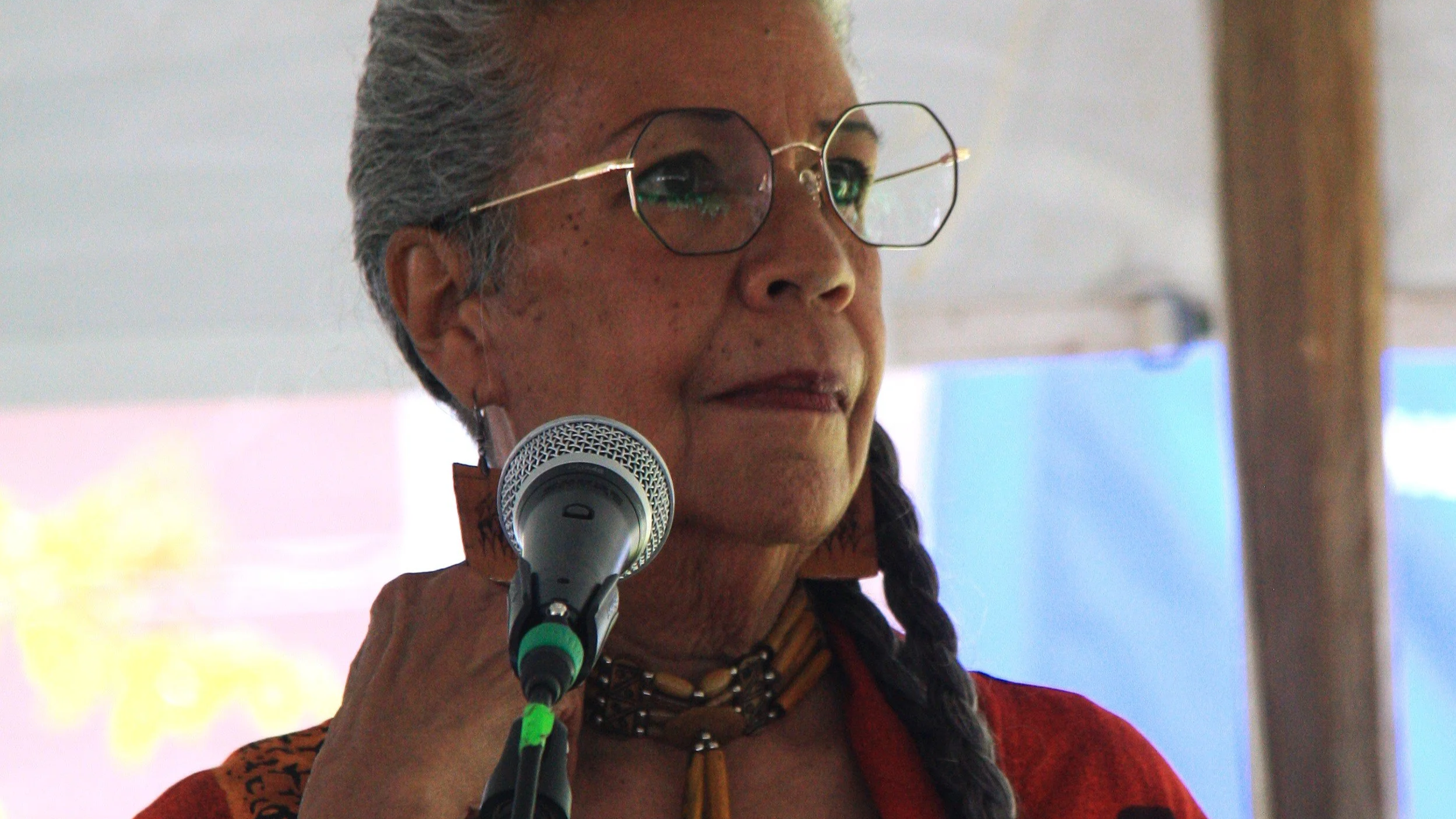
Representatives of the tribes whose ancestors died at Peskeompskut spoke at the Day of Remembrance, among them Liz Cold Wind Santana-Kiser, elder and council member of the Chaubunagungamaug Band of Nipmuck Indians. Photo courtesy of Carol Fournier
“How do you right a wrong? Some say you can’t. Some say you can, bit by bit. In this place called Peskeompskut.”
- David Brule, Nolumbeka Project
How do you decolonize a landscape? How do you right a wrong?
Some say you can’t, it’s been too long. Some say you can, bit by bit, help to heal the river, the land, entire nations of those who named this place: call it Peskeompskut, or Peske-Tuk, Pesquamskut, Wissatinnewag.
Think about the stepping stones that have led to May 16, 2026, and this Day of Remembrance.
Wissatinnewag was saved from Wal-Mart, the Ceremonial Hill at the airport was saved from the bulldozer, the great drums of the Pocumtuck Homelands Festival booming out along the river and up the shady streets of the village, sweet flute music lifting into the air and helping the healing at the falls.
Then there’s especially the completion of a 12-year study by Indigenous people and local historians diving deep into history to find out what really happened at the falls on May 19, 1676.
And now we celebrate the return to the Indigenous nations of a very small symbolic parcel of what was a continuously inhabited, 12,000-year campsite before the slaughter of the innocents in May 1676.
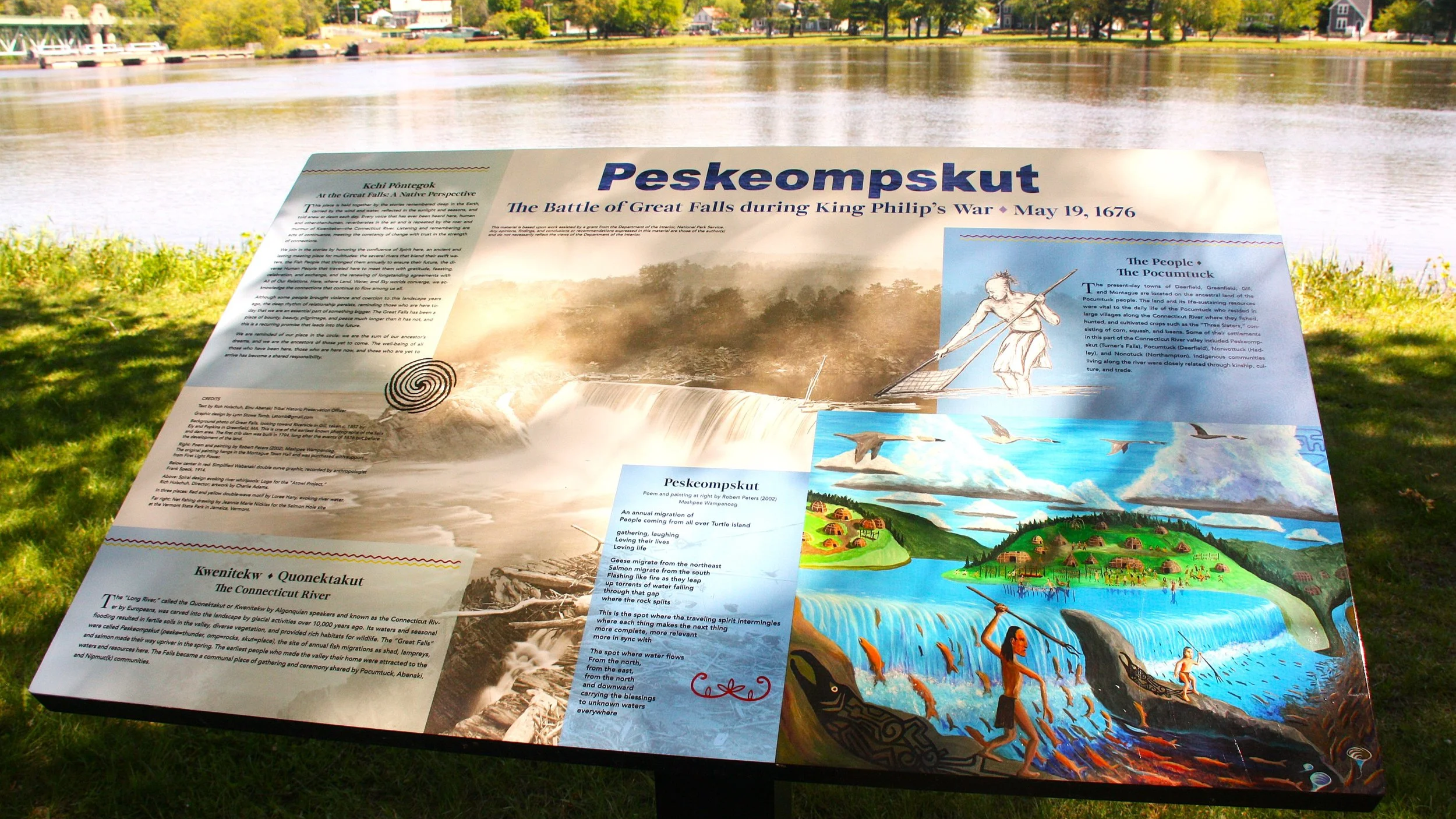
New signage, written by members of the Nipmuck and Abenaki tribes and the Nolumbeka Project, now sits on the river front, telling a fuller story. Photo courtesy of Carol Fournier
The place at the head of the falls holds many memories from before 1676, when for 12,000 years it was a joyous gathering place for Native nations from all over the Northeast.
I ask you to imagine tribal peoples from hundreds of miles around converging on the campsites and villages at Peskeompskut as they had for thousands of years. Nipmuc, Wampanoag and Massachusetts paddle down the Paguag (Millers) River from the regions of Mount Wachusett and beyond.
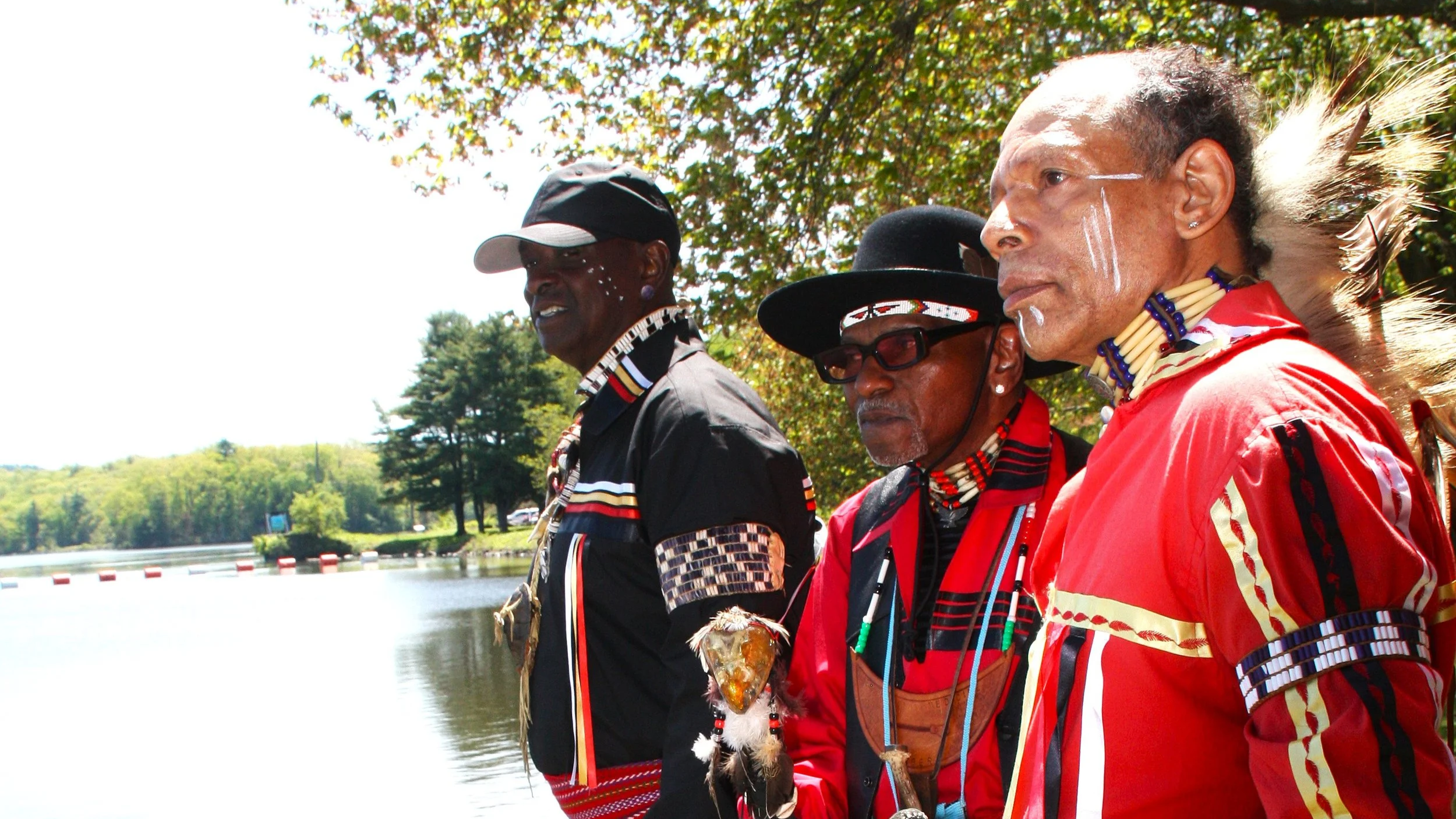
Eastern Medicine Singers members Rick Snow Elk Swenson, David Grey Owl Jennings and Daryl Black Eagle Jamieson on the banks of the Kwinitekw, the Connecticut River, at Unity Park, Turners Falls, Mass., following the opening of the Day of Remembrance, May 16, 2026. Photo courtesy of Carol Fournier
Abenaki, Pennacook, Sokoki stream down from the north. Mohican arrive from the west, Narragansetts from the southeast, extended families of the Pocumtuck confederation of Agawam, Woronoco, Norwottuck and Nonotuck move upriver to the falls.
Hundreds of wetus and wigwams dot the fertile shores above the roaring Falls.
Shouts of joy and yelping dogs join in the greetings of those just arriving….
For 12,000 years, but no more. On May 19, 1676, the long history of peace, sanctuary, abundance, and spiritual renewal was destroyed for native people in the valley.
As Nipmuck storyteller Basket Maker recounts in Kelly Savage’s book, The Pond Dwellers, musket fire awakened children in the predawn darkness, blood spurting over the survivors. People screamed, elders were run through by sword after Col. William Turners told his men to save their gunpower and use their long knives.
The People hid in crevices in the rock cliff of Peskeompskut, but they were rooted out and killed. Others leapt into the roaring cataract to their deaths at the foot of the falls. Nearly 300 men, women and children perished.
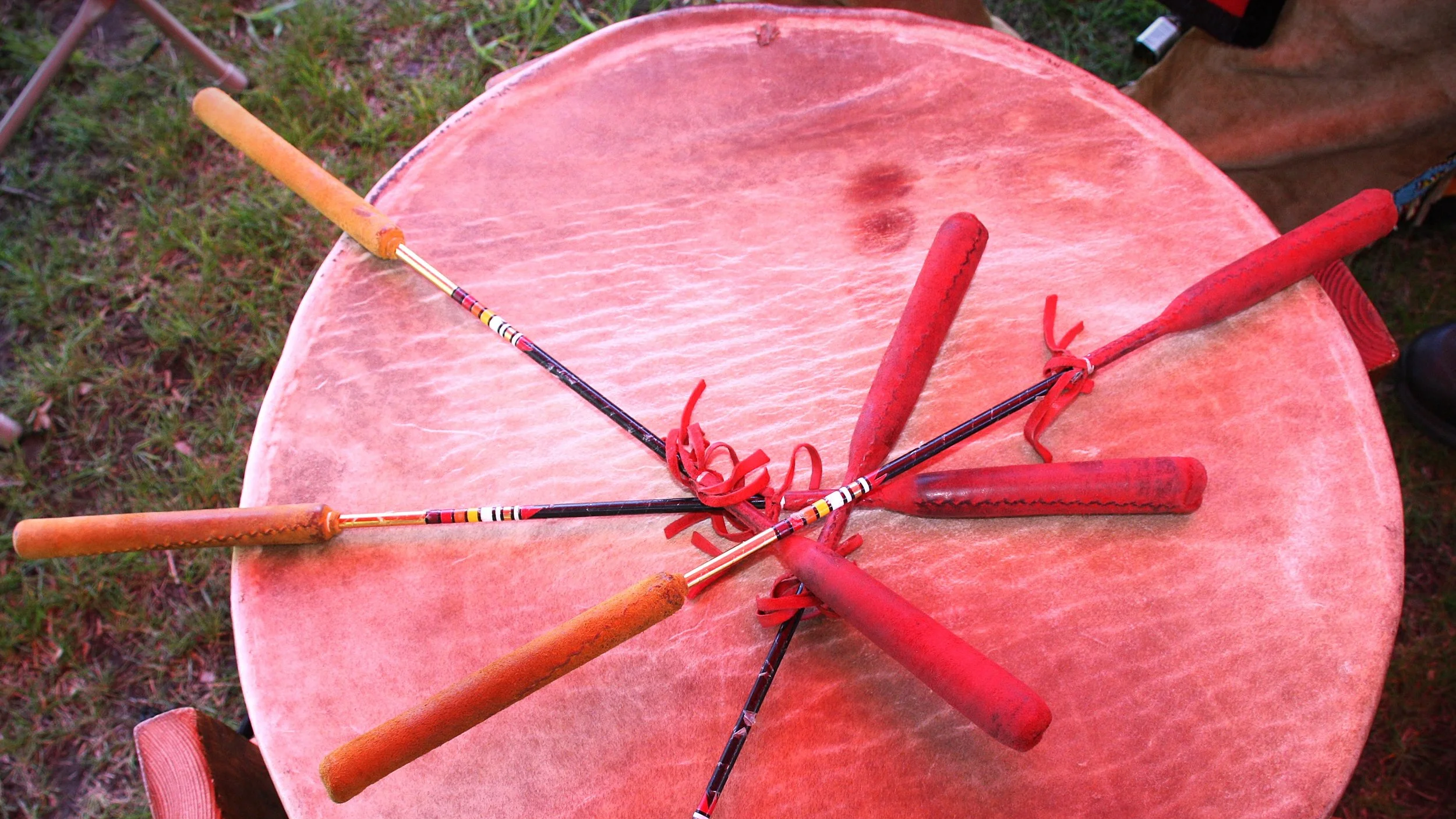
A sacred drum at the Day of Remembrance, May 2026. Photo courtesy of Carol Fournier
How has this massacre been remembered?
In 1900, colonial descendant Timothy Stoughton donated a plot of land to the Pocumtuck Memorial Association for a memorial to the “battle between the English under Captain William Turner, and the Indians.” The memorial, which still stands, read:
Captain William Turner/ With 142 men surprised and / Destroyed over 300 Indians / Encamped at this place / May 19, 1676
The colonists “wrote in bloody characters the concluding chapter in the history of the Pocumtucks as a nation,” intoned a speaker at the September 1900 dedication of the memorial. “[F]rom this very ground, [colonial forces] swept the Indians to the river below…and freed our valley forever from the thraldom of barbarism.”
George Sheldon, then head of the Pocumtuck Memorial Valley Association, flattered the crowd with his assurances that they were the descendants of those destined to rule: “You live on classic ground. Nowhere in New England was there a more vital question of the 17th century finally settled: should the Indian or the Englishman dominate the valley of the Connecticut?” The rightful answer, for him, was clear.
And so it was over all those centuries: a repeated story of battle, the heroism of Turner and his forces, and the justifiable extermination of the Indian tribes.
But that was the way then. This is now, and a new perspective on the story has emerged.
On May 16, 2026, 350 years after the atrocity of 1676, the wrong committed then was moved just a few degrees into being righted.
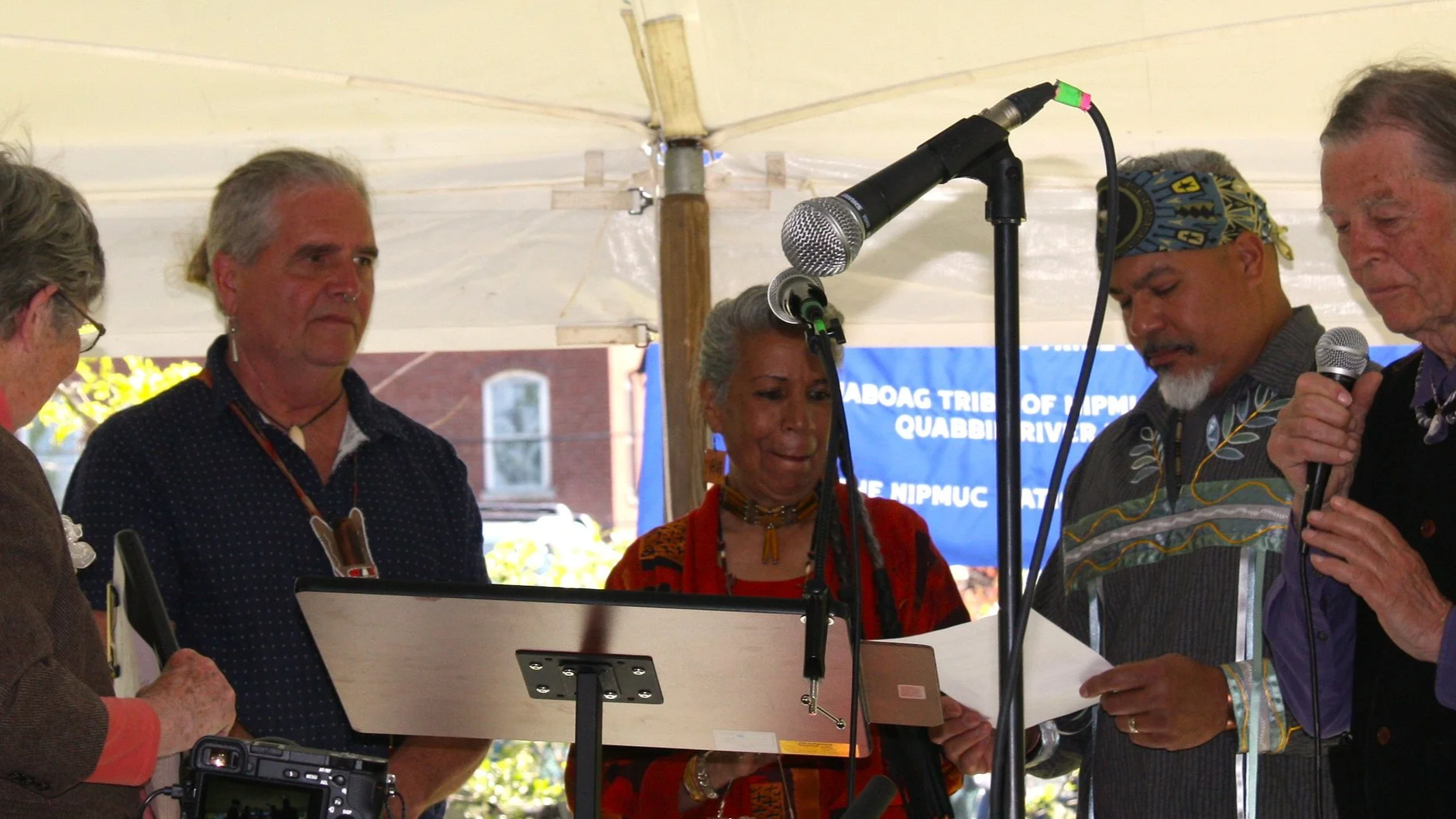
Left to right: Carol Letson, president, Pocumtuck Valley Memorial Association; Rich Holschuh, founder, Atowi Project, Tribal Historic Preservation Officer, Elnu Abenaki; Liz Cold Wind Santana-Kiser, elder and council member of the Chaubunagungamaug Band of Nipmuck Indians; Jose "Ite" Santana, chair, Chaubunagungamaug Band of Nipmuck Indians, founder and director of Nipmuck Cultural Hunt and Fish; David Brule, Niantic, president, Nolumbeka Project during the transfer of land grant of the Turner's Fall's monument property from the Pocumtuck Valley Memorial Association to the Abenaki, Nipmuck and Nolumbeka Project Communities, May 16, 2026, near Peskeompskut Falls at Turner's Falls, Mass. Photo courtesy of Carol Fournier
The Pocumtuck Valley Memorial Association turned over the deed of the plot and monument to an Indigenous coalition who has now taken over ownership.
A procession of 60 people crossed the Turners Falls-Gill bridge to the site where the slaughter was memorialized.
We reached the site, a roughly 30 by 20 foot rectangle, nowadays its surface reduced by intruding sidewalks, the widened Route 2 with its heavy traffic, across the way a gas station, and other businesses on the site where so many died.
The roar of the passing trucks and cars was the backdrop to the commemorative speeches where 60 people gathered in May 2026.

Strong Eagle Many Feathers Daly, Nipmuc, an artist, wooden flute creator, and musician, prepares to offer his musical gifts at the 350th Day of Remembrance near Peskeompskut Falls, May 16, 2026. Photo courtesy of Carol Fournier
Dr. Margaret Bruchac, Abenaki scholar, standing before the memorial stone tribute to William Turner, spoke to the crowd: “The narrative style of historical erasure has been repeated so often, and weaponized by so many, that the sheer emotional impact of these words has nearly obscured the truths of that history.
“We are here today to tell a very different story - one, not of Indigenous erasure, but one of Indigenous survival, persistence, and continuance, against all odds. In thanks and remembrance of all of our relatives, across time.”
In contrast to her predecessor George Sheldon, the current president of the PVMA council, Carol Letson, said that she was “here to honor the Indigenous peoples of the region surrounding the Connecticut River,” and transfered ownership of the monument and the land beneath it to the Nolumbeka Project and its Indigenous partners, the Nipmuck and Abenaki tribes.
“This is the time to acknowledge that so much land was taken by colonists, farmers, early governments,” she continued. “The events that occurred here make this location important to our understanding of the long-standing effects of the past.”
We returned across the river, across the bridge, pausing long enough to let fall an offering of fish, tobacco, sweetgrass, and shadbush flowers to the thundering falls below.
The Nolumbeka Project and the Nipmuck and Abenaki tribes have launched a drive to create and place an Indigenous symbol on the plot to counterbalance the memorializing of the massacre on the Turner monument. Please donate via the Nolumbeka Project website.
Carol Fournier, photographer for Remembering & Reconnecting: 350 Years after the Great Falls Massacre, can be reached at CAFournierArts@gmail for permission to use these photographs.
Dave Weed of the Sowams Heritage Area Project also captured photos and stories of the Day of Remembrance. See them here.
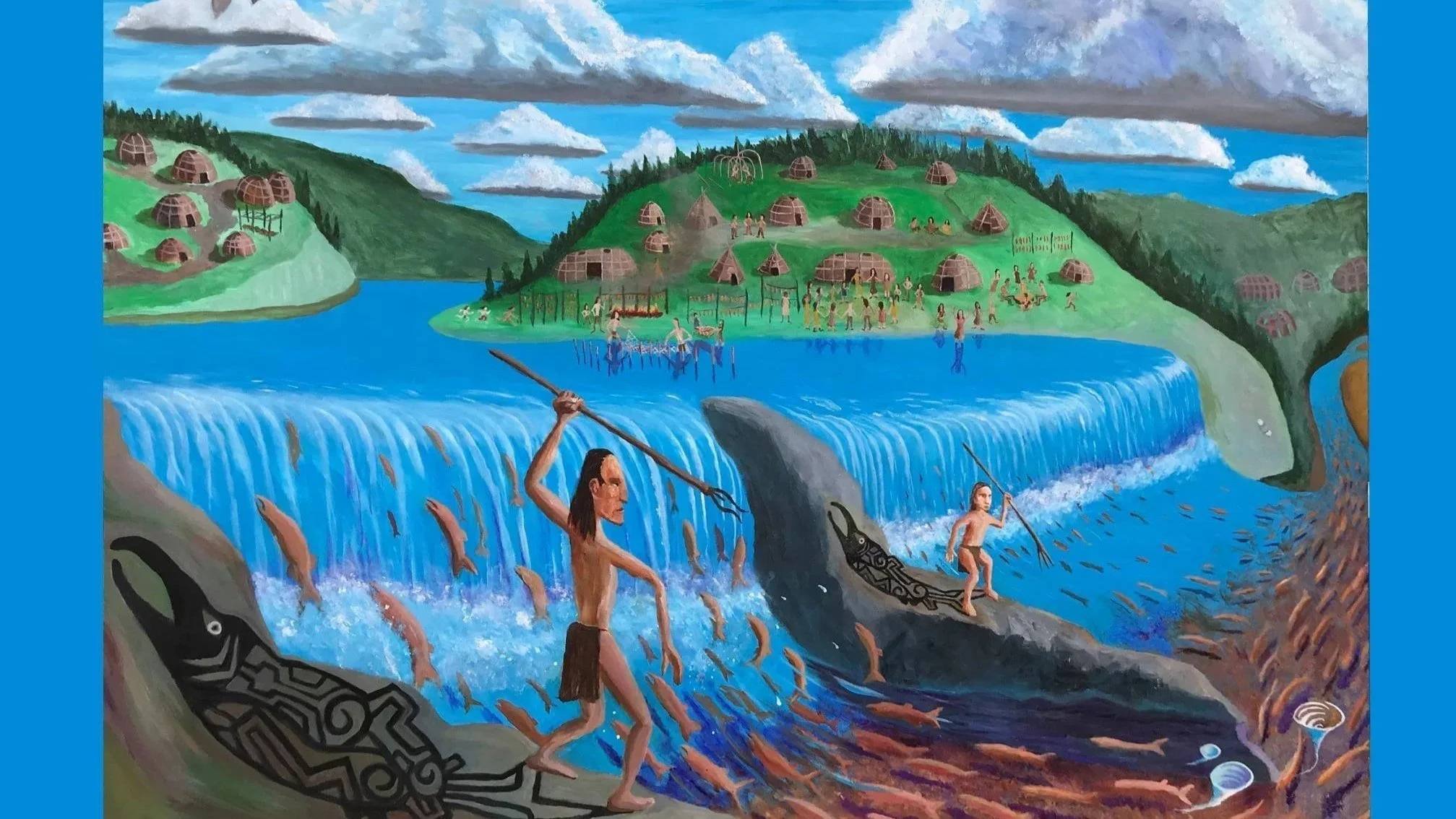
"Peskeompskut," by Mashpee Wampanoag artist Robert Peters, shows life at Peskeompskut, or Turners Falls, where Indigenous people gathered to fish, celebrate and come together in the years before the fatal massacre of 1676.