
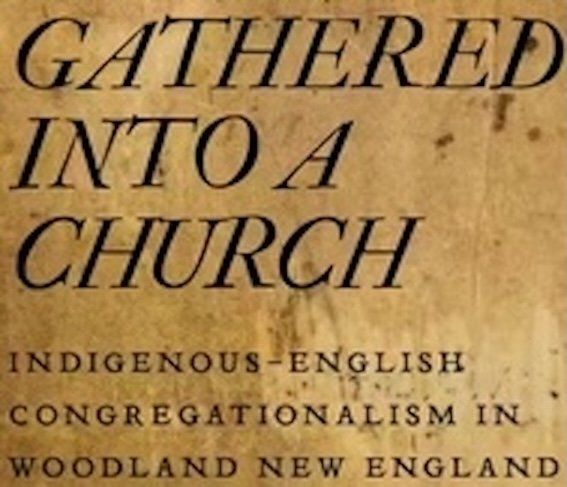
Cover of Gathered into a Church, winner of the Massachusetts Historical Society 2026 Peter J. Gomes Memorial Book Prize.
Many of you know independent scholar Lori Rogers-Stokes from her presentations for PHB and her brilliant moderating. She’s the author of the groundbreaking book Records of Trial from Thomas Shepard’s Church in Cambridge, 1638-1649: Heroic Souls (Palgrave Macmillan, 2020), which revolutionised the understanding of women in Congregationalism. Her even more groundbreaking Gathered into a Church: Indigenous-English Congregationalism in Woodland New England, published by the University of Massachusetts Press in 2025, is the winner of the 2026 Massachusetts Historical Society’s prestigious Peter J. Gomes Memorial Book Prize.
Gathered into a Church: Indigenous-English Congregationalism in Woodland New England (Amherst: University of Massachusetts Press, 2025), 288pp. is reviewed by Stephen Hahn, professor emeritus of English, William Paterson University.
A little over half a century ago, if a person had raised the question of early church records in the vicinity of the town of Rowley, Massachusetts, one might have heard that they were illegible, gone missing, destroyed or otherwise not accessible. A further question regarding the historical presence of Indigenous people in the community would probably have been met with startled condescension, for being so naïve. Gone, too.
We owe it to the diligence of scholars such as Lori Rogers-Stokes that we now have not just access to records but an account of life in numerous early churches “gathered,” as they said, in congregations in parts of Woodland New England.
Rogers-Stokes has worked for many years reading and transcribing thousands of pages of documents and to open up a multi-dimensional view into congregational history otherwise lost. Her account, compactly presented in this book, also includes a recognition and assessment of the role of Indigenous people in creating those congregations. The inclusion of Indigenous people as full members and not slaves or menials in the four principal communities represented here - Agawam/Rowley, N’ahteuk/Natick, Noepe/Martha’s Vineyard, and Hassanamesit/Grafton - is a fact awakening us to attend to discoverable records rather than received ideas to about what happened in puritan New England in the long 17th century.
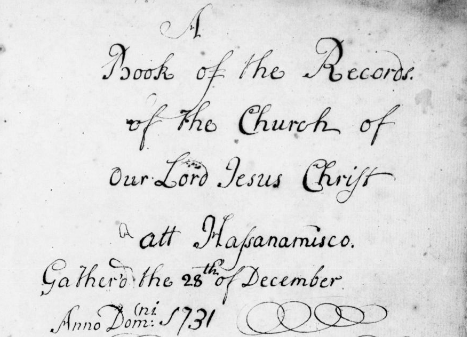
As a researcher, Rogers-Stokes gives evidence of painstakingly and meticulously recovering lost stories, as well as a lack of presumption in sorting out tangled skeins of entries in church records. Her presentation of materials is clear and orderly, illuminating the pattern in her material rather than imposing a preconceived pattern on it.
She is also quietly open to the critical theological issue, crucial for contemporary readers if they are to overcome habitual cynicism regarding religious belief and Indigenous/English settler relations, did the members of these congregations believe what they said they believed, and did they act accordingly? That is, did they actually share the central religious experience of assurance (or lack thereof), and did Indigenous members share an experience of the same (and not merely feign to do so for purposes of survivance).
She concludes that English settlers and Indigenous members of these communities understood themselves to be more alike than different in matters of faith.
Gathered into a Church is concise. The author recognizes but does not elaborate distractedly on other paths of questioning and observation about the larger socio-political and historical moment (i.e., regarding the displacement of and genocical wars against Indigenous people). And while admittedly not telling the whole story of each congregation across five centuries; she covers fully the period (c. 1640-1730?) of the first generations. The result is a book both scholarly, in a friendly way, and quite readable.
Watch Lori’s presentation now!
Stephen Hahn is a professor of English emeritus, William Paterson University. A native of Essex county, Massachusetts, he currently lives in Falmouth, Maine. He currently teaches at the Maine Coastal Senior College.